

In Part I of this series, we traced how a Maddie’s‑backed MOU shifted money and decision‑making out of the public arena. This second part looks at the unusually high number of hoarding and cruelty victims in Pima County, and what their existence and fate say about Tucson’s ‘lifesaving’ experiment and the new model being watched across the country.
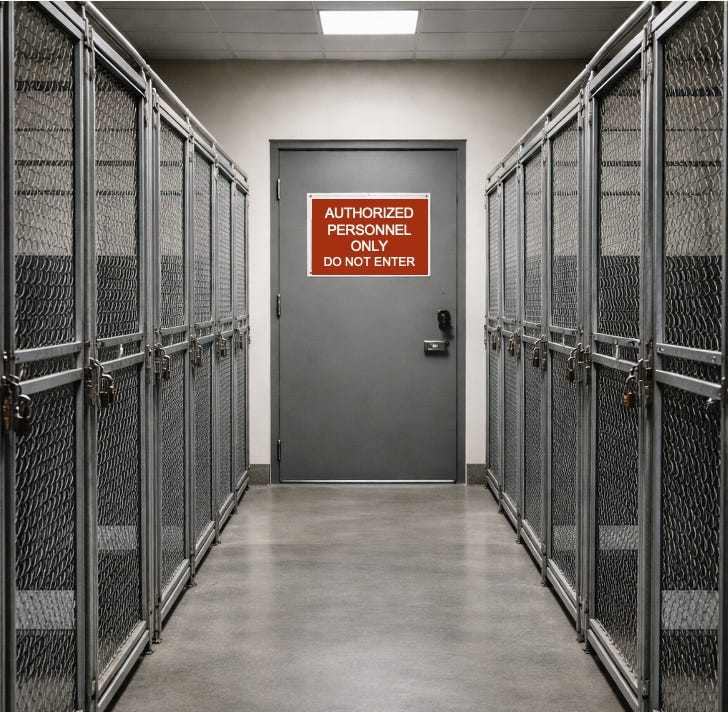
When the county cut the ribbon on its new Animal Restoration Kennels, Pima Animal Care Center (PACC) leaders described the off‑site complex as a long‑overdue answer to hoarding and cruelty cases that had overwhelmed the shelter for years. Dozens of neglected dogs, they promised, would finally get space, medical care, and time to heal without displacing the steady flow of strays and owner surrenders crowding PACC’s main kennels.
For dogs like “Shana” (a composite of recent hoarding victims), that promise means the difference between being euthanized under “urgent census” conditions and being moved into a separate bank of quiet runs, out of public view, to see if trauma and behavior can be turned around.
In Part I of this series, Animal Politics traced how a $1.9 million Maddie’s Fund grant and a 25 page MOU with Friends of PACC and the Humane Society of Southern Arizona shifted power and funding in Tucson’s shelter system while leaving prevention thin and kennels full.
This second part turns to the dogs who don’t fit neatly into the “lifesaving” storyline, the hoarding and cruelty victims now housed in off‑site Animal Restoration Kennels, and asks how visible they will be in the numbers and narratives that PACC presents to the public, officials, and other communities looking for a model.
What ARK is on paper
Nothing in the record suggests that animals housed at ARK will be denied care or intentionally mistreated. The concern is different and more structural: that animals living and dying in an off-site, non-public facility may fall outside the statistics, dashboards, and narratives by which the public evaluates whether the system is working.
Pima County’s Board of Supervisors approved the ARK plan in December, authorizing a lease for roughly 80–90 kennels at an off‑site facility operated by Central Pet/Colibri and designating the space for animals seized from hoarding and neglect cases. County sources estimate that dozens of ongoing hoarding investigations involve over 1,000 animals in Pima County, with ARK pitched as a way to help those dogs and cats without further congesting an already over‑capacity shelter.
According to PACC, its Animal Protection Services team is already working “over 50 cases involving households with 10 or more animals in neglectful or unsafe conditions,” having removed 537 animals in 2025 and estimating more than 1,000 additional animals still in similarly crowded homes.
For a single county, those are striking numbers, especially layered onto a municipal shelter that routinely warns of dangerous overcrowding and asks residents to hold onto found dogs or “rehome” their pets because the municipal shelter is full.
Local coverage and county press releases describe ARK as a limited‑access, county‑run operation: not open to the public, situated away from the main PACC shelter, and intended for animals needing extended medical and behavioral rehabilitation before they can safely enter the adoption floor.
PACC Director Steve Kozachik told Animal Politics that the goal is to “affirmatively begin to address hoarding concerns that due to our high census in the shelter we have previously not been able to address,” adding that other jurisdictions will be watching to see what Pima gets wrong and right.
Who owns it, who funds it
On paper, ARK is a county facility. Kozachik told Animal Politics that “the ARK is solely a county‑run facility,” operating under PACC’s policies, records‑retention rules, and public‑records laws, with no formal governance or data‑management role for Friends of PACC or other donors. He says he conceived the idea himself and negotiated the agreement with the facility owner, stressing that “all of the funding is private donations” rather than county general funds or Maddie’s dollars.
County communications detail those private sources: a $60,000 gift from philanthropist Elizabeth “Betsy” Bruce and her family foundation; a $50,000 contribution from the Scarritt Foundation; and additional support from Friends of PACC’s Lovely’s Fund for Abused and Neglected Animals. Bruce’s own profile in Tucson Lifestyle notes that she has funded hoarding‑case support at PACC, including a large fenced yard and psychological care for people involved in animal hoarding situations.
Friends CEO Torre Chisholm told Animal Politics that PACC is “spearheading the project,” that Friends is “simply managing the community donations that support it,” and that the group made a single direct contribution from Lovely’s Fund because ARK’s focus on abused and neglected animals aligned with donor intent.
That blend, county lease and operation, donor‑funded build‑out, and Friends managing restricted contributions, has impressed some local advocates as an example of philanthropy stepping up for the hardest cases, while confusing others who are trying to understand exactly where public accountability ends and nonprofit discretion begins.
As one advocate texted Animal Politics, “Is ARK fully under PACC’s data‑transparency obligations, or has Friends of PACC unnecessarily inserted itself in a way that shields the facility behind a private nonprofit?”
Governance, optics, and a small circle of decision‑makers
The Scarritt Foundation’s emergence as a key ARK funder has drawn particular scrutiny inside Tucson’s animal‑welfare community. Scarritt is a relatively new nonprofit, founded to support animal welfare and related causes, with a small board and little animal welfare experience.
To address feedback that it had focused on high‑dollar galas rather than community outreach, Scarritt recently brought on an ex‑HSSA marketing executive who resigned during the “318” small‑pets scandal, a hiring choice that some critics say risks importing unresolved trust issues into ARK’s funding orbit.
The optics are further complicated by Scarritt’s addition of attorney Timothy Medcoff to its board; Medcoff is a partner in Farhang and Medcoff, the same firm where then‑partner Robert Garcia served as HSSA board chair during the 318 controversy and remained in that role as the organization weathered accusations of record‑keeping failures and efforts to expand into Cochise County.
None of this proves wrongdoing at ARK. But for advocates who watched the 318 case unfold, the overlapping cast, HSSA, its former volunteers and donors, its counsel, and now a new foundation helping fund off‑site kennels, raises concerns about whether a narrow circle of insiders is once again making decisions about some of Tucson’s most vulnerable animals with limited outside oversight.
How ARK animals are counted
The central question for a data‑driven “lifesaving” system is straightforward: where do ARK animals appear in the numbers. In response to detailed questions from Animal Politics, Kozachik said PACC “will be keeping a separate accounting of animals at the ARK until they are transferred to PACC and are available for adoption.”
That means dogs and cats seized from hoarding and neglect cases will be tracked in a distinct bucket, separate from the main shelter’s intake and outcome reports, until the point they are deemed ready for the general population.
When a community is already acknowledging more than 50 hoarding cases and an estimated 1,000 animals still in neglected homes, the decision to house many of those victims in an off‑site, non‑public facility tracked in a separate accounting stream is not a technical detail; it creates a gap in public reporting that can make Tucson’s true overpopulation crisis, and the full scope of its shelter needs, appear smaller than it actually is.
These unusually high numbers of hoarding cases did not occur in a vacuum. They appear to stem primarily from limited neighborhood‑level sterilization efforts, compounded by chronic shelter overcrowding and a system that relies on managed intake and call centers prioritizing metrics over prevention.
County press materials emphasize that ARK allows PACC to help at‑risk animals “without jeopardizing positive outcomes for animals already in the shelter,” a phrase that has been widely echoed in local coverage. The practical implication is that, for some span of time, hoarding and cruelty victims can live, improve, decline, or die entirely within an off‑site facility that is not open to the public and is not reflected in the headline statistics PACC uses to show progress on “lifesaving” goals.
Kozachik’s separate‑accounting plan has sharpened worries among some advocates that Tucson is building exactly the kind of “just outside the numbers” population Part I warned about. One community member asked bluntly in a text, “once the approx 1000 hoarding cases [animals] are cleared is the non-transparent kennels used for strays etc etc,” voicing a fear that an off‑site, non‑public complex could quietly expand beyond law‑enforcement cases into a catch‑all for overflow or behavior‑complicated dogs.
Another advocate questioned whether “an estimated 1,000 animals” might pass through ARK with only partial visibility in intake and outcome statistics in a system already shaped by managed intake and transports.
Neither PACC nor Friends has yet published a clear plan for how ARK animals will appear in public dashboards, Shelter Animals Count submissions, or annual reports once the facility is fully operating.
Kozachik has said ARK animals will be transferred into standard PACC records when they become available for adoption, but has not specified whether euthanasia, long‑term holding, or out‑of‑county transfers from ARK will be reported in the same way as outcomes from the main shelter, a gap that risks inflating PACC’s live release rate by counting ARK “successes” in the numerator while leaving some ARK “failures” out of the denominator.
A “model” that isn’t officially a model
In Tucson Sentinel’s coverage, Friends CEO Torre Chisholm is quoted saying that he is not aware of similar programs elsewhere and that ARK “could be a model for other communities.” In follow‑up correspondence, he narrowed that claim, telling Animal Politics that he was referring to the reality that many communities are struggling with overwhelmed caretakers and hoarding cases, and that “there will be lessons from the ARK project that could be helpful to other communities,” not to any formal pilot or replication plan.
He emphasized that “there haven’t been discussions with groups outside of Pima County about this being a pilot for replication and it has no connection to the assistance programs being supported by Maddie’s Fund.”
Kozachik similarly described ARK as an experiment that other jurisdictions will “be watching to see how this works out, and learn from our mistakes, and from the areas we get it right,” while asserting that “this has nothing to do with Maddie’s” and that he developed the concept independently.
Taken together, those statements place ARK alongside, rather than inside, the Maddie’s collaboration documented in Part I of this series: a county‑run, donor‑funded off‑site facility built in the same ecosystem of private partners and national “lifesaving” messaging, but not formally branded as a Maddie’s project.
Even so, the structure is familiar. Part I showed how a Maddie’s grant and MOU in Tucson under‑invested in high‑volume spay/neuter while expanding call centers, managed intake, and nonprofit control over funding streams and data.
In Riverside County, California, a taxpayer lawsuit is now challenging a roughly $2.5 million consulting contract with Outcomes for Pets, led by former PACC director Kristen Hassen, arguing that “extraordinary” fees for a managed‑intake, community‑animal model should instead be redirected toward spay/neuter, emergency medical care, and core shelter capacity.
ARK is not part of that lawsuit, but it sits in the same larger debate: whether scarce dollars and political will should go toward off‑site facilities and consultancy‑aligned frameworks, or toward the unglamorous work of preventing hoarding and neglect cases from erupting in the first place.
Prevention vs. Warehousing
Supporters of ARK describe it as a humane alternative to leaving hoarding victims stacked in crates in a public shelter that is already warning of “dangerous capacity” and begging for emergency fosters. They point out that these animals often require months of slow, careful work, treating skin infections, decompressing behavior, and building basic trust, conditions that are hard to provide in an overstressed county facility where dogs routinely share kennels and sleep in hallways.
Critics do not dispute that animals seized from hoarding and cruelty cases need somewhere to go. Their concern is that, without clear public reporting rules and a serious prevention strategy, ARK risks becoming a pressure valve that protects “lifesaving” metrics while the same upstream conditions continue to generate new hoarding clusters.
Pima County still lacks the kind of sustained, neighborhood‑saturating spay/neuter effort that reduced shelter intake elsewhere; the Maddie’s‑backed MOU in Tucson, as Part I documented, committed to relatively modest sterilization and clinic targets while prioritizing downstream Pet Support Centers, transports, and call‑center‑driven deflection.
Whistleblowers and advocates argue that donors who care deeply about hoarding and cruelty, including Scarritt and Bruce, could have just as powerfully funded a multi‑year campaign of mobile MASH‑style sterilization and targeted veterinary outreach in the zip codes where hoarding cases recur.
Bruce’s own record, funding a hoarding‑case yard, animal rescue facilities, disability services, and even paying off a stranger’s mortgage, underscores how much impact committed philanthropists can have when they pick a strategy.
The question Part II raises is whether channeling that money into an off‑site response facility, without matching investments in prevention and transparent data, will reduce the number of Shanas in crisis or simply give the system one more place to put them.
The dogs who live in the gap
For a dog like Shana, seized from a house where dozens of animals live amid waste and hunger, ARK offers both a reprieve and a risk. On the one hand, she may get more time, quieter housing, and specialized care than she would have if she entered the main shelter at a moment when PACC is publicly pleading for people to foster “even for a week or two” just to make space.
On the other hand, she begins her county journey in a facility that is not open to the public, tracked in a separate accounting system, and only later, if her behavior and health improve enough, transferred into the adoption stream and the statistics that define PACC’s “lifesaving” success.
That gap between where Shana lives and where she is counted is where this investigation will keep its focus. In a system built around downstream live‑release rates, managed intake, and narrative‑driven “lifesaving” interventions, the off‑site hoarding kennels at ARK are a test of whether Tucson can bring its hardest animals and neighborhoods fully into the light, or whether a new facility, paid for by private donors and tracked in separate ledgers, will simply move the most inconvenient suffering off the books.
Together, the Maddie’s collaboration (Part I) and the launch of ARK sketch a future in which more of Tucson’s shelter work occurs through private contracts, off‑site facilities, and curated ‘lifesaving’ metrics that the public can’t easily verify, while upstream prevention again takes a back seat to downstream strategies dependent on a permanent sense of crisis.
PACC leaders say ARK was created to give hoarding‑case animals a better chance than they have in the main kennels; the measure of that promise will be whether every ARK animal, win or lose, is transparently counted in the same public data as every other animal in Pima County’s care.
In Case You Missed It:
For more background visit the Animal Politics Archive and type “PACC” in the search engine at the top of the list of articles.

Ed Boks is the former executive director of animal care and control agencies in New York City, Los Angeles, and Maricopa County, and a past board member of the National Animal Control Association. His work has appeared in the Los Angeles Times, New York Times, Newsweek, Real Clear Policy, Sentient Media, and now on Animal Politics, a lively community spanning 48 states and 61 countries.
If you enjoyed this article, consider subscribing to Animal Politics. Your support fuels independent research, reporting, and discussion shaping the future of animal welfare.
I help people spay/neuter their pets in the Central San Joaquin Valley (CA). The cases I work with are kind people that took in strays but couldn't afford to have them altered so numbers multiplied. The hoarding cases I see are all linked to lack of access to spay/neuter.
I can't imagine using resources to build and operate a separate facility to deal with hoarding without proactive spay/neuter.
I live in Pima County. When I first heard of this new endeavor, I had many questions, most importantly, how would they have the resources to provide veterinary and behavior care onsite? It is hard enough to provide these things on-site at the main facility. I am very concerned about warehousing these animals rather than getting them the care they deserve.