
When Does Shelter Medicine Become Shelter Management?
The unanswered questions surrounding “transitional medication” in America’s animal shelters.

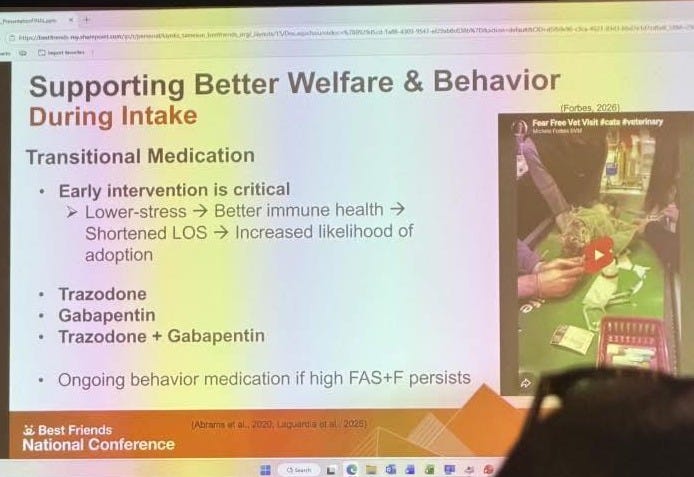
A slide from the 2026 Best Friends National Conference in Salt Lake City appears to show trazodone, gabapentin, and trazodone plus gabapentin presented as “transitional medication” for shelter dogs during intake. It ties those drugs not only to lower stress, but also to better immune health, shorter length of stay, and an increased likelihood of adoption.
That is the story. Not because these drugs can never help a dog. They can. The issue is whether influential shelter organizations are beginning to normalize psychoactive medication as part of routine intake management while key questions about evidence, oversight, reassessment, and disclosure remain unanswered in public.
When Animal Politics asked Best Friends Animal Society and Fear Free to explain the boundaries of that practice, neither provided a substantive answer by deadline.
The Slide
Best Friends says its national conference is a place where animal welfare leaders gather to share practical strategies for saving more animals and reducing shelter killing. Among the materials now circulating from that conference is a slide titled “Supporting Better Welfare & Behavior During Intake,” listing trazodone, gabapentin, and trazodone plus gabapentin under the heading “Transitional Medication.”
The wording matters. Rather than describing case-by-case veterinary treatment for individual dogs, the slide appears to frame trazodone and gabapentin as components of a shelter-wide management strategy intended to improve population-level outcomes, including reduced stress, shorter length of stay, and increased adoptions.
In a field strained by overcrowding and long stays, that is not a minor clinical point. It suggests a management philosophy in which medication becomes part of the intake strategy rather than solely an individualized clinical intervention.
The Evidence Gap
The use of psychoactive medication in shelters is no longer unusual. A 2025 Journal of Shelter Medicine and Community Animal Health survey of 148 shelters and rescues found that trazodone and gabapentin were the most commonly used anxiolytic medications for fearful dogs, and many respondents reported comfort using them and perceived them as effective.
But widespread use is not the same thing as settled science. The same study said more work is needed to understand efficacy, safety, and the role of these drugs in shelter care.
A 2021 review noted that evidence supporting some behavioral uses of these medications in dogs remains limited and that distinguishing sedation from true anxiety relief can be challenging. Those scientific questions deserve continued study.
One veterinarian with extensive shelter consulting experience who spoke with Animal Politics said the more immediate issue inside shelters may be whether staff are distinguishing fear-based cases from other forms of arousal or aggression before dogs are medicated, evaluated, and placed.
Even if future research ultimately answers those questions in favor of these medications, another set of questions remains: how are they governed once they become part of routine shelter operations?
Koret’s Reach
This debate does not exist in a vacuum. Animal Politics has previously reported on the influence of the Koret Shelter Medicine Program and other Maddie’s Fund-backed institutions in shaping the modern shelter playbook. In that model, academic programs help generate research and guidance, national organizations help promote it, and shelters across the country are urged to adopt it as best practice.
That context matters here because Koret publicly frames two concerns about trazodone and gabapentin, that they cause sedation and mask aggression, as “myths.” At the same time, Koret’s own public guidance says animals receiving these medications should be monitored throughout their shelter stay for side effects and therapeutic response.
That combination raises an important question. One of the field’s most influential academic voices publicly characterizes concerns that these medications sedate dogs or mask aggression as “myths.” That is a stronger position than the more cautious tone found in parts of the broader review literature.
Yet Koret also acknowledges that dogs on these drugs require monitoring and reassessment. That is precisely why this issue deserves scrutiny beyond a single conference slide. When many of the same institutions participate in research, professional education, conference training, and the dissemination of best practices, questions about independent review and transparency become more important, not less.
Governance and Disclosure
Whether a medication primarily reduces anxiety, produces mild sedation, or does some combination of both is an important scientific question. But for shelters, the more immediate public-interest questions are operational.
Neither Best Friends nor Fear Free has publicly explained what proportion of shelter dogs, if any, receive transitional medication, how long treatment typically continues, or under what circumstances medication is initiated. Without that information, the public cannot determine whether this practice is exceptional, selective, or routine.
When is “transitional medication“ initiated? Who authorizes its use? Under what written protocol? How long is treatment expected to last? Who decides when it should be discontinued? Are behavioral evaluations conducted while the dog is receiving the medication? If so, how is that documented?
Equally important is disclosure. If a dog is currently receiving psychoactive medication, what are adopters, foster caregivers, rescue partners, and receiving shelters told before they make placement decisions?
Those questions go beyond clinical judgment. They concern transparency, informed decision-making, and public trust. They also affect whether adopters, fosters, rescue partners, transporters, and receiving shelters are encountering a dog whose presentation may be altered by medication without being told so.
Oversight in Real Shelters
Public shelter-medicine guidance says animals receiving trazodone or gabapentin should be monitored throughout their shelter stay for side effects and therapeutic response, especially sedation and other changes that could affect handling or evaluation. That sounds sensible on paper. It becomes harder in practice when shelters are overcrowded, understaffed, and holding dogs for long periods.
Who performs reassessments? How often? Are they documented in the medical record? Is continued medication reviewed by a veterinarian? Are behavioral evaluations conducted before or after medication begins? Are shelters clearly distinguishing fear-based cases from other forms of arousal or aggression before using these medications? Are adopters, foster caregivers, rescue partners, transporters, and receiving shelters informed that a dog is currently receiving behavioral medication and whether treatment is expected to continue?
These questions matter because medication may influence how a dog presents during handling, behavioral evaluation, or placement discussions, particularly if reassessment and disclosure are inconsistent.
The central governance question is whether shelters have reliable protocols for distinguishing fear and anxiety from other forms of arousal or aggression before medication is prescribed, behavioral evaluations are performed, or placement decisions are made.
These are governance questions, not philosophical ones. They determine whether transitional medication functions as individualized veterinary treatment or as a standardized behavior management tool within an overcrowded shelter system.
This is where the phrase “transitional medication“ deserves closer examination. Transitional to what? Better welfare? Or greater manageability within a stressed shelter system?
The Response Pattern
Animal Politics asked Best Friends whether it recommends trazodone and gabapentin as routine transitional medication at intake, what evidence supports their use in high-stress shelter settings, what safeguards it recommends against masking serious behavior issues, and what disclosure practices it expects when medicated dogs are presented to adopters or rescuers.
Animal Politics also asked Best Friends to identify the session, presenter, and supporting materials associated with the slide. Best Friends did not provide a substantive answer by deadline. As of publication, Animal Politics had not received the conference materials or supporting evidence requested for the presentation.
Operation Kindness confirmed that Dr. Abbie Atteberry presented a session at the 2026 Texas Unites for Animals Conference titled “The Med, The Myth, The Legend: Animal Behavior Medications in the Shelter” on April 26, 2026, but said no slide deck or other presentation materials were made available for distribution and could not confirm whether the specific slide reviewed by Animal Politics was used there. Public Best Friends materials identify Atteberry as a veterinarian on the organization’s National Shelter Medicine team.
Animal Politics also invited Dr. Atteberry to provide any additional context regarding the use of transitional medication in shelters and will update this article if a response is received.
Fear Free was asked whether it endorses the use of trazodone or gabapentin in shelters, what safeguards it recommends to prevent masking of behavior problems, and what disclosure guidance it gives when medication may alter an animal’s presentation. Fear Free replied that it needed input from veterinary and shelter-medicine experts and could not comment by deadline.
Both groups may still respond, and if they do, their answers will be included in full. But for now, the public is left with an unsettling gap: the drugs are common, the subject is being presented at multiple professional conferences, the institutional influence is well documented, and the most basic public-facing explanations are still missing.
Why This Matters
The question is not whether trazodone or gabapentin can ever help a dog. They can, and veterinarians use them for legitimate reasons. The real question is whether shelter leaders are beginning to treat behavior-modifying medication as part of routine intake and throughput strategy before the field has resolved the core issues of evidence, oversight, reassessment, and informed disclosure.
If these drugs are being used carefully, with individualized veterinary judgment, consistent monitoring, documented reassessment, and clear disclosure, shelters should say so and make those standards public. If they are being used primarily as operational tools to manage overcrowding or reduce length of stay, that deserves public scrutiny as well.
For now, the clearest public record is still that slide. It appears to present pharmacologic intervention not as a last resort, but as part of a shelter population intake strategy for managing behavior, length of stay, and adoption outcomes.
Until Best Friends and Fear Free publicly explain whether they view transitional medication as individualized veterinary care or as a routine shelter-wide behavior management tool, that conference slide will continue to raise more questions than it answers.
Additional Reading
Troubling Allegations of Medication Misuse at NYC Animal Care Centers
Behind the Bars: The Hidden Dangers of Medication in Animal Shelters

Ed Boks is the former executive director of animal care and control agencies in New York City, Los Angeles, and Maricopa County, and a past board member of the National Animal Control Association. His work has appeared in the Los Angeles Times, New York Times, Newsweek, Real Clear Policy, Sentient Media, and now on Animal Politics, a lively community spanning 49 states and 75 countries.
Animal Politics is reader-supported. If this reporting matters to you, a paid subscription is the most direct way to keep it going.
In my experience rescuing and rehabilitating Rottweilers, some dogs—especially strong, confident males—react poorly to trazodone. Instead of calming them, it can leave them confused, anxious, and distressed, and a dog with no history of aggression may lash out simply because it is struggling with the altered state.
If these dogs are evaluated or handled while medicated, their behavior may not reflect their true temperament. Reactions seen during drug-induced confusion should not be taken as their normal personality.
Imagine being given a powerful sedative, placed in an unfamiliar and threatening environment, and expected to function normally while strangers approached and handled you. Fear and defensive reactions would not be surprising. Dogs deserve the same consideration. Using drugs on dogs in shelters may promote behaviors shelters are trying to alleviate!
Those drugs 1000% mask aggression. It’s ridiculous to suggest otherwise.